Canine Cognitive Dysfunction: Dog Dementia Signs (and What Else It Could Be)
Advertising disclosure: this article may contain affiliate links. We may earn a commission at no extra cost to you. It never changes our advice. How we fund our work
He's standing in the kitchen, facing the wall. Not sniffing, not waiting for anything. You say his name and there's a beat before he turns, like he had to find his way back to you.
Canine cognitive dysfunction syndrome (CCDS) is the dog version of dementia: a degenerative brain condition that changes behavior, memory, and sleep. The key sign is slow change over months across several areas at once, not one bad week. Vision loss, pain, infections, and hormone problems can look identical, and those are treatable, so the first step is always a vet visit, not a label.
What canine cognitive dysfunction actually is
CCDS is a progressive decline in brain function in older dogs, with tissue changes that resemble human Alzheimer's disease. It's common, underdiagnosed, and easy to mistake for ordinary aging. The screening basics and the diagnosis gap are in signs your dog is slowing down; this article is about what the signs look like at home.
How common it is, and who's most at risk
The largest dataset comes from the Dog Aging Project, which analyzed 15,019 dogs in a 2022 paper. The odds of cognitive dysfunction rose about 52% with each additional year of age. And among dogs of the same age, health, and breed type, dogs described as inactive had 6.47 times the odds of cognitive dysfunction compared with very active dogs.
That second number is an association, not a cause: dogs with early decline may simply move less. It's still a reason to keep an older dog walking and sniffing, as long as his joints allow it.
The signs, letter by letter (DISHAA)
Vets screen with an acronym, DISHAA, used in the AAHA senior care guidelines and by Cornell's Riney Center. Each letter is a category of behavior.
Disorientation
He goes to the hinge side of the door and waits. He stands behind the couch and can't work out how to get back. He stares at a wall or into a corner. He walks into the yard, then seems unsure why he's there. Each moment is small, which is why this is the sign owners recognize last.
Changes in how he interacts with you
A dog who met you at the door for ten years now stays on his bed when you come home. Or the reverse: an independent dog now follows you room to room and can't settle unless he's touching you. Less interest in petting, other dogs, or a guest he used to love. Sometimes irritability for no clear reason.
Sleep-wake changes
The daytime is quiet and the night isn't. He sleeps heavily through the afternoon, then paces, whines, or wanders the hallway at two in the morning. This reversal is one of the more distinctive patterns, and one of the hardest on the household.
House soiling
A dog who was reliable for a decade urinates indoors, sometimes right after coming in from the yard. He stops signaling that he needs to go out, or goes to the door and forgets why. This one needs a urine test before it gets called dementia, because a bladder infection produces the same accidents.
Activity: pacing, staring, or doing less
Some dogs do less: less exploring on walks, less play, less interest in a toy. Others do more, but aimlessly: pacing the same loop, licking the same patch of floor, staring into space. Repetitive, purposeless movement is the clue, not the amount.
New anxiety
A dog who was steady becomes clingy, startles at ordinary sounds, or panics when left alone for the first time in his life. Anxiety that appears late, with no event to explain it, is a common thread in cognitive dysfunction.
Learning and memory
He forgets a cue he's known since puppyhood. He doesn't recognize a familiar visitor. He can't learn where the water bowl is after you move it. Cornell adds this category to the standard six; it usually shows up after the others.
Early signs owners usually miss
The first changes rarely look like a brain problem:
- The pause before responding to his name. Not deafness, because he still hears the treat bag. A delay, as if he's processing.
- Waiting in front of a closed door when the open one is three feet away.
- Getting "stuck" behind furniture or under a table, and needing help out.
- Less greeting. Still glad to see you, but the ritual has shrunk.
None of these alone means anything. Three of them, building over a season, are a pattern.
Dementia or normal aging?
| What you notice | More like normal aging | More like cognitive dysfunction |
|---|---|---|
| Sleeping more | Longer naps, settled at night | Sleeps all day, restless or vocal at night |
| Slower to respond | Takes a moment, then comes | Seems not to register you, or looks confused |
| Less play | Shorter sessions, still enjoys them | Forgets the game midway, or stares at the toy |
| Bathroom habits | Needs to go out more often, still asks | Accidents indoors, no signal, sometimes right after a walk |
| Moving around the house | Careful on slick floors and stairs | Gets lost, stuck in corners, waits at the wrong door |
| Mood | A bit more set in his ways | New anxiety, clinginess, or irritability with no trigger |
Dementia or something your vet can treat?
Several conditions produce the same behaviors, and most can be treated. A 2023 study of 804 dogs (Wrightson and colleagues) found that pain, sensory loss, and mobility problems all went along with higher cognitive decline scores. That's why the guidelines require ruling those out first.
| Condition | How it usually starts | The clue that points elsewhere |
|---|---|---|
| Vision loss | Gradual, worse in dim light | Bumps into things at night, fine by day; hesitates in new places |
| Hearing loss | Gradual | Ignores his name but not the treat bag; startles when touched from behind |
| Pain or arthritis | Gradual, worse after rest | Night restlessness with stiffness; withdrawn but still oriented |
| Urinary infection or kidney disease | Days to weeks | Accidents plus more drinking, straining, or frequent small pees |
| Cushing's or thyroid disease | Months | Thirst, appetite, coat, and belly changes alongside the behavior |
| Brain tumor | Weeks, and keeps worsening | Seizures, circling one way, one-sided weakness, steady decline |
| Old dog vestibular disease | Sudden, over hours | Head tilt, flicking eyes, falling; usually improves in 2–3 weeks |
The timeline does a lot of the sorting. Cognitive dysfunction creeps in over months. Vestibular disease arrives in an afternoon and, per MSPCA-Angell, usually improves within two to three weeks. A brain tumor tends to get worse in a straight line. An infection shows up in a urine test. The workup isn't there to prove your dog has dementia; it's there to find the things that aren't.
How vets diagnose it: the 2025 guidelines
In December 2025, JAVMA published the first guidelines for diagnosing and monitoring CCDS, from a working group led by Dr. Natasha Olby at NC State. They set two levels of diagnosis. Level 1 is a detailed history, a physical and neurological exam, and lab work to exclude other causes. Level 2 adds an MRI, for cases where something else, like a tumor, needs ruling out.
The guidelines also recommend routine cognitive screening from age seven, and a structured questionnaire every six months from age ten.
Mild, moderate, severe
Mild means a few signs that don't disrupt the household much. Moderate means signs in several categories that affect daily life. Severe means frequent disorientation, lost house training, and a dog who needs significant support. Staging gives you and your vet a marker to compare against in six months.
The questionnaires: DISHAA, CCDR, CADES
Three tools show up most often. The DISHAA questionnaire scores each category; Cornell's version reads 4–15 as mild, 16–33 as moderate, and above 33 as severe. The CCDR (Canine Cognitive Dysfunction Rating scale, Salvin 2011) has 13 items and reached 98.9% diagnostic accuracy in its validation study. CADES (Madari 2015) has 17 items across four domains and tracks progression.
Fill one out, bring it to your vet, and redo it in six months. A score is a conversation starter, not a diagnosis.
A two-week log to bring to your vet
Vets see your dog for twenty minutes, in a room where every dog is alert. Two weeks of notes from home are worth more. Organize them by DISHAA letter, and for each entry note the time, the frequency, and what happened just before:
- D: where he got lost or stuck, and at what time of day
- I: greetings skipped, clinginess, any irritability, and with whom
- S: when he settled at night, when he woke, how long he paced
- H: every accident, where, and how soon after his last trip outside
- A: pacing, staring, licking, or the things he's stopped doing
- A: new fears, and what set them off
Then film one episode: a minute of him staring at the wall, or standing at the wrong door, tells your vet more than any description. Add every medication and supplement he's on, with start dates, since confusion is a side effect of several common drugs.
How fast does it progress?
The CADES study tracked this. Over six months, 42% of dogs rated as normal aging moved into mild impairment, and 24% of mildly impaired dogs became moderate. Over twelve months, those figures were about 71% and 50%.
Treat those numbers with care: they come from one study population, and individual dogs vary widely; some plateau for a long time. What they do say is that "wait and see" has a cost.
What can be done
There's no cure. There are things that can slow the picture or make it easier to live with, with uneven evidence. A 2025 survey of 318 US veterinarians in Frontiers in Veterinary Science found selegiline used by 67.6%, therapeutic diets by 61.2%, and melatonin by 54.2%, yet only 29.2% named selegiline as the most effective option. Most vets combine approaches.
Prescription treatment
One prescription drug exists for this condition: selegiline, approved by the FDA on December 10, 1998, for canine cognitive dysfunction syndrome. It interacts with several other medications and isn't right for every dog, so whether to use it is your vet's call.
Therapeutic diets and supplements
Diets built around medium-chain triglycerides (MCTs) and antioxidants have the best study behind them: a 2018 double-blind trial (Pan and colleagues) of 87 dogs found improved cognitive scores on the enriched diet. That's one study, with a modest number of dogs, and not every dog responds. Supplements have thinner evidence. Talk to your vet before changing his food or adding anything, especially if he's on medication.
Keeping him moving and thinking
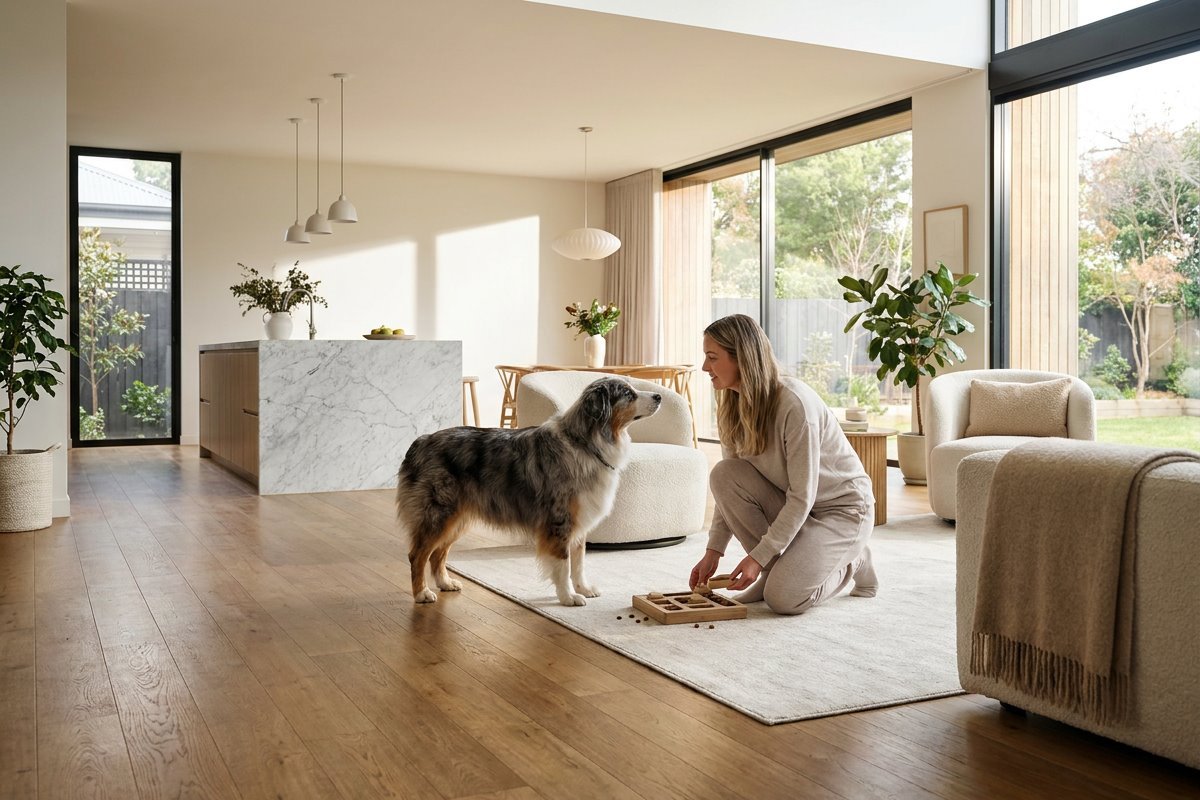
Enrichment costs nothing and has no side effects. Short, slow "sniff walks" where he chooses the route. A kibble scatter on the lawn instead of a bowl. Simple food puzzles he can still solve. Five minutes a day reviewing an easy cue, for treats. Meals and walks at the same times every day. The goal is a brain that keeps getting used, without frustrating him.
Small changes at home
Night-lights, rugs on slick floors, and blocked-off stairs reduce the getting-stuck and the falls; the full walkthrough is in dog struggling with stairs.
As the condition progresses, quality-of-life decisions are a conversation to have with your vet, gently and early, using the same scores you tracked from the start.
Red flags: when it's probably not dementia
🚨 Same day
- Sudden onset, over hours or days rather than months
- A seizure
- Head tilt, flicking eyes, circling one way, or falling
- Weakness on one side, or pupils of unequal size
- Sudden blindness
- New, intense aggression, or signs of severe pain
- Straining to urinate with nothing coming out
- Refusing food and water
Cognitive dysfunction is slow; anything fast is something else until proven otherwise. The general list of senior red flags is in signs your dog is slowing down.
Frequently asked questions
What are the first signs of dementia in dogs?
The earliest signs are usually small and easy to explain away: standing at the hinge side of a door, staring at a wall, waking at odd hours, a dog who used to greet you and now doesn't, or a house-trained dog having accidents. Any one of these can have another cause. Several together, building over months, are worth a vet visit.
At what age do dogs get dementia?
Signs usually begin after eight, and risk keeps climbing with each year. Data from more than 15,000 dogs in the Dog Aging Project found the odds of cognitive dysfunction rose about 52% with every added year of age. The 2025 veterinary guidelines recommend routine screening from age seven and a questionnaire every six months from ten.
How fast does dog dementia progress?
Faster than most owners expect, but it varies. In one study using the CADES scale, 42% of dogs with normal aging moved to mild impairment within six months, and 24% of mild cases became moderate; at twelve months those figures were roughly 71% and 50%. Some dogs stay stable for years, so your vet's rechecks matter more than any average.
How long can a dog live with dementia?
There's no honest number. Cognitive dysfunction on its own isn't fatal, and many dogs live with it for years while other age-related conditions decide the timeline. What changes is quality of life, and that's a conversation to have with your vet as things progress, using the same questionnaire scores you started with rather than a guess.
Is there medication for dog dementia?
Yes, one prescription drug. Selegiline was approved by the FDA in 1998 for canine cognitive dysfunction syndrome. Whether it suits your dog depends on his other conditions and medications, and only your vet can decide that. It isn't a cure, and it doesn't help every dog. Diets and supplements are also used, with less evidence behind them.
Can dog dementia be reversed?
No. Cognitive dysfunction is a degenerative brain condition, and nothing currently reverses it. What can change is the pace and the day-to-day picture: some dogs improve on treatment, enrichment, and routine, at least for a while. And some of what looks like dementia is a treatable condition, which is why the vet visit comes first.
Sources
- NC State News — Guidelines for Diagnosing and Monitoring Canine Cognitive Decline
- JAVMA — Consensus Guidelines for CCDS (December 2025)
- AAHA Trends — First-Ever Guidelines for Canine Cognitive Dysfunction
- Cornell Riney Center — Senior Dog Dementia
- AAHA — Managing Cognitive Dysfunction (2023 Senior Care Guidelines)
- VCA — Senior Pet Cognitive Dysfunction
- VCA — Selegiline
- FDA — Selegiline Approval, Freedom of Information Summary (1998)
- Frontiers in Veterinary Science — Survey of US Veterinarians on CCDS (2025)
- PubMed — Salvin et al. (2011), Canine Cognitive Dysfunction Rating scale
- Madari A, et al. (2015). Assessment of severity and progression of canine cognitive dysfunction syndrome using the CAnine DEmentia Scale (CADES). Applied Animal Behaviour Science.
- PMC — Yarborough et al. (2022), Dog Aging Project
- PMC — Wrightson et al. (2023), pain, sensory loss, and cognitive decline
- PMC — Pan et al. (2018), MCT and antioxidant diet trial
- MSPCA-Angell — Vestibular Syndrome in Old Dogs