My Dog Barks at Everything: A Room-by-Room Fix
Advertising disclosure: this article may contain affiliate links. We may earn a commission at no extra cost to you. It never changes our advice. How we fund our work
Before you teach a single cue, walk through your house and count the things your dog can see, hear and smell from wherever it spends the day. Most people find between six and a dozen. That is not a training problem — it is a floor plan problem, and it can be fixed this afternoon.
Barking is a response to a trigger, so the fastest reduction comes from removing triggers rather than training tolerance to all of them. Block the window view, mask the hallway sounds, move the bed away from the front door, and you cut the number of daily rehearsals dramatically. Then train the handful you cannot remove.
First: why removing triggers beats training them
Every bark at the window is a repetition. The mail carrier arrives, the dog barks, the mail carrier leaves — and from the dog's point of view the barking worked. Do that four times a day for a year and you have roughly fifteen hundred successful rehearsals of the exact behavior you are trying to reduce.
You cannot out-train that while it keeps happening. Behavior professionals call the first step management, and it is not cheating — it is the thing that makes the training possible.
The living room
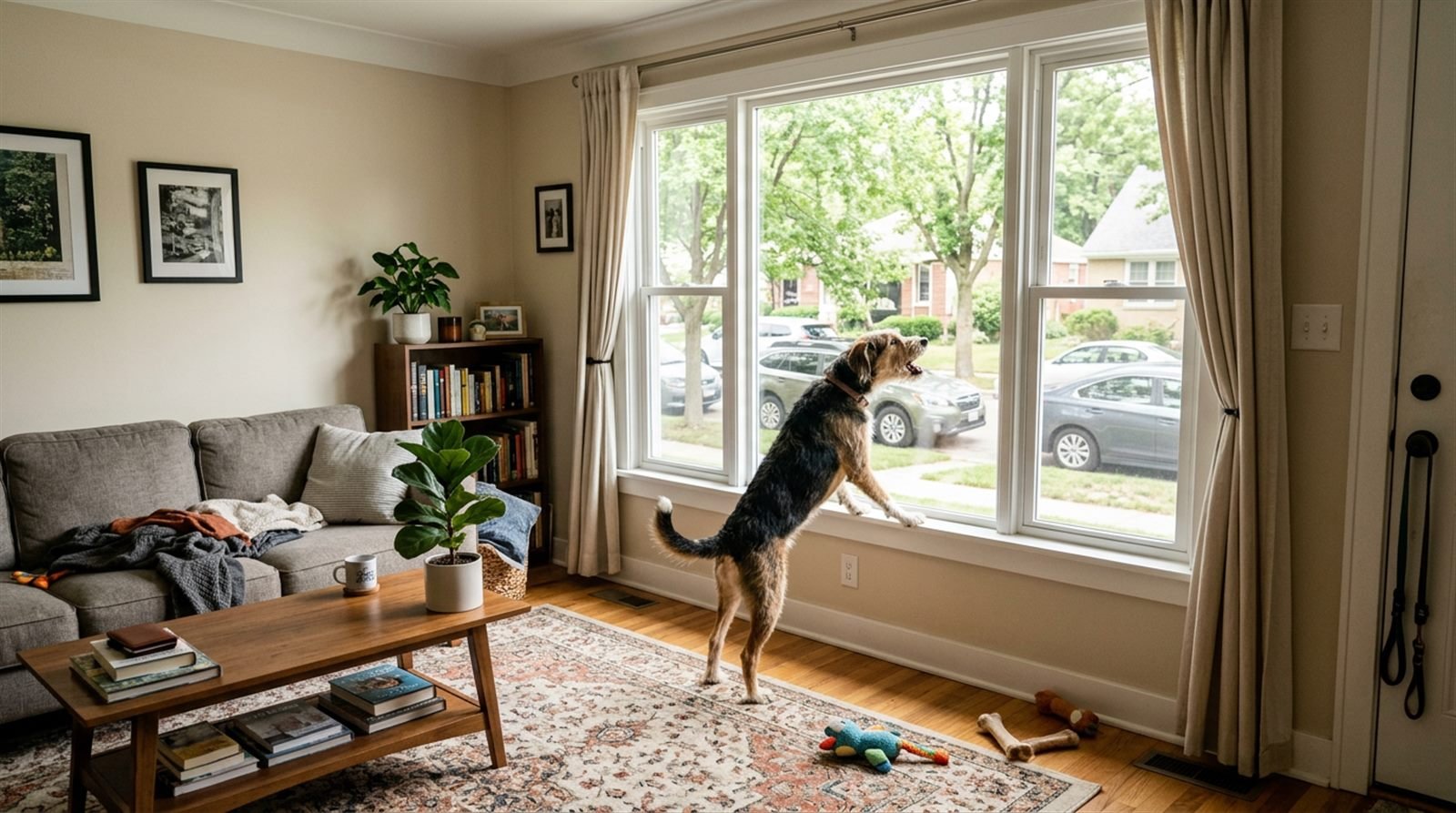
The front window is usually the single biggest source. Frost the lower half with adhesive window film, or move the sofa the dog stands on. Light still comes through; the parade outside stops.
Check the sightline from the dog's bed. Lie down where your dog lies down and look. If the bed faces the front door or a window onto the street, turn it around or move it to an interior wall.
Add steady background sound. Broadband noise — a fan, an air purifier, white noise — masks distant doors and footsteps better than music, which has sudden loud moments of its own.
The hallway and front door
The doorbell is a trigger you can simply switch off. Mute it or turn the volume down and put a note asking for a knock. Most people never think of this, and for doorbell-reactive dogs it removes the loudest cue in the house.
Use a barrier during delivery hours. A baby gate that keeps the dog out of the entry hall during the busy window means the trigger arrives without the dog being able to charge the door.
Deliveries are predictable. If your packages land between one and three, that is when the dog does something else — a chew, a puzzle, a different room.
The yard and the fence
Fence-line barking is self-reinforcing in the same way: the dog on the other side always leaves eventually. Solid panels or fence screening on the shared section removes the visual. Supervised yard time in the busy hours removes the opportunity.
The kitchen and everywhere else
Some barking is aimed at you rather than the outside world: barking for food, for attention, for the walk. That kind responds to what you do rather than what you move — being reliably boring while it happens, and reliably generous a few seconds after it stops.
The distinction is worth making before you pick a strategy. Ignoring works beautifully for attention barking and does nothing at all for a dog barking at the window.
Then train the ones you cannot remove
Once the count is down from twelve triggers to three, training becomes realistic. Use the same technique as everything else on this site: at a distance or volume where your dog notices but does not react, pair the trigger with something excellent. Recorded doorbell sounds at low volume work well here, because you control the intensity exactly.
The full method is in our counterconditioning guide — and the same ordering rule applies: trigger first, food second.
Why anti-bark collars are not on this list
The AVSAB's position statement recommends reward-based methods only and specifically discourages aversive tools including shock collars. Beyond the welfare question there is a practical one: suppressing the sound leaves the reason intact. A dog that is worried about people outside and has learned that barking hurts is still worried about people outside — it has just lost its way of saying so.
When barking is a medical sign
A noticeable increase in barking in an adult dog, particularly an older one, deserves a veterinary exam before a behavior plan. Pain, hearing and vision decline, and canine cognitive dysfunction all commonly show up as new noise or increased vocalising. The AAHA behavior guidelines treat ruling this out as a routine first step, not an afterthought.
Frequently asked questions
Why does my dog bark at everything all of a sudden?
A sudden increase in barking in an adult dog deserves a veterinary check first. Pain, hearing or vision decline, and cognitive change in older dogs all commonly present as new noise sensitivity. Once medical causes are ruled out, look for a change in the environment such as new neighbors, a new delivery pattern or a moved piece of furniture.
Do anti-bark collars work?
The American Veterinary Society of Animal Behavior recommends reward-based methods only and discourages aversive tools including shock collars. Suppressing the bark does not address why the dog is barking, and for an anxious dog it can add fear to a situation that already worries them.
Should I ignore my dog when it barks?
Ignoring works for barking that is maintained by your attention, and does nothing for barking triggered by something outside. Identify what the bark is aimed at first. If it is the window, the fix is the window.
Is it cruel to stop a dog from barking?
Reducing the triggers is not cruel; it usually improves the dog's day considerably. A dog patrolling a window and barking for hours is not enjoying itself. What is unfair is punishing the sound while leaving the dog in the situation that causes it.