Senior Dog Losing Weight: When It's Age, and When to Call the Vet
Advertising disclosure: this article may contain affiliate links. We may earn a commission at no extra cost to you. It never changes our advice. How we fund our work
You lift him onto the couch and he feels lighter. Or your hand finds a ridge of spine you don't remember. Then the thought you've been avoiding: is this age, or is it something?
Losing some muscle with age is common. Losing weight, a number that keeps dropping, isn't something age does by itself: there's a cause, and usually a more ordinary one than cancer, like a sore mouth or aging kidneys. Weigh him, log it, bring the log to your vet. A 5% loss with no change in food or exercise deserves a visit this week.
Is it normal for an old dog to lose weight?
Muscle loss with age is expected. It shows over the back, hips, and head while weight and appetite stay the same.
Weight loss is different. A healthy senior doesn't lose weight because he's old; he loses it because he's taking in less, absorbing less, or burning more. "He's just getting old" describes what you see. It doesn't explain it.
Most older dogs who lose weight don't have cancer. But a falling number always deserves a question, not a shrug. (Senior brackets by size are in when a dog is considered senior.)
Fat or muscle? They're not the same problem
Owners say "he's thinner." Vets ask: thinner in what?
What age-related muscle loss looks like
Slow, symmetrical, quiet. The hindquarters narrow over a year or two; the head and shoulder blades feel more defined. Appetite, stools, and the scale stay put, and he's still excited about dinner and the walk.
What real weight loss looks like
The number moves. Ribs that took some pressure to find now show when he turns; the waist tucks sharply from above. It usually brings company: a change in thirst, eating, stool, or energy. Loss over weeks, not years, is the version to take seriously.
Why your dog can lose muscle and weigh exactly the same
Vets score fat and muscle separately. The WSAVA body condition score rates fat on a 9-point scale; its muscle condition score rates muscle on its own 4-level scale: normal, mild, moderate, or severe loss. They don't move together: a dog can score a plump 7 for fat and still have moderate muscle loss along his spine. When muscle goes and fat fills in, the scale reads the same for months. Check both.
How much weight loss is actually concerning
No published rule says "this many percent, call the vet." The numbers that recur in veterinary literature are 5% and 10%. The sensible reading: 5% with no change in diet or exercise gets a visit booked this week; 10% gets the clinic's first opening.
| Your dog's normal weight | 5% loss | 10% loss |
|---|---|---|
| 8 lb | 0.4 lb (6 oz) | 0.8 lb (13 oz) |
| 15 lb | 0.75 lb (12 oz) | 1.5 lb |
| 30 lb | 1.5 lb | 3 lb |
| 50 lb | 2.5 lb | 5 lb |
| 70 lb | 3.5 lb | 7 lb |
| 90 lb | 4.5 lb | 9 lb |
The baseline is his healthy adult weight (ask your clinic).
Where these numbers come from
One place they show up clearly is cancer research. The Merck Veterinary Manual reports that approximately 14% of dogs lose 5–10% of their body weight, and 23% of dogs lose more than 10% of their body weight, in the 12 months before a cancer diagnosis. That's the anchor for 5% and 10%.
Read it carefully. It looks backward from dogs who already had cancer; it says nothing about how many dogs who lose weight have it, and most don't. Dental, kidney, and gut disease are more common, and more treatable. The numbers say when to start checking, not what the check will find.
How to check at home this week
The bathroom-scale method — and why small dogs need it most
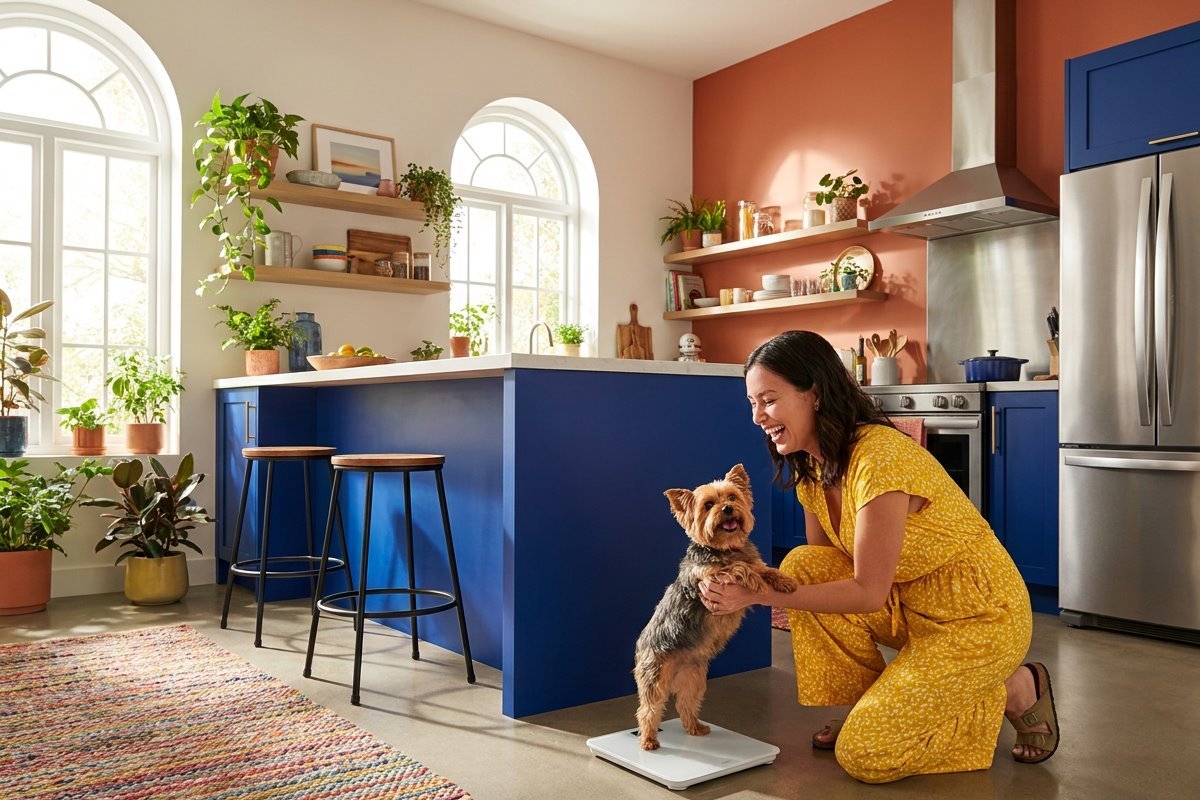
Eyes and arms are bad at this, and worse the smaller the dog. Our own dog is a Yorkie, about eight pounds. Ten percent of her, the number the literature flags, is under a pound. Under a pound on a dog you pick up twenty times a day is nothing your arms will register, and a full coat hides it from your eyes. That's not a medical finding; it's arithmetic.
Weigh yourself, weigh yourself holding the dog, subtract. It works up to about 25 pounds; above that, the scale's rounding swallows the change, so ask to use the clinic's walk-on scale, usually free. Same weekday, same time, before a meal, on a hard floor, never carpet. Write it down.
Body condition score: the 9-point check with your hands
The WSAVA chart runs from 1 (emaciated) to 9 (obese); 4 to 5 is ideal. With the dog standing:
- Ribs. Run flat hands along his sides. Ideal feels like the bones on the back of your hand: easy to find under a thin cover. Having to press suggests extra fat; a washboard, too thin.
- Waist. From above, a visible tuck behind the ribs.
- Belly. From the side, the line from ribs to groin rises, not sags.
AAHA's nutrition guidelines put numbers on the heavy end only: every incremental increase in body condition score is equivalent to a 5% increase in body fat percentage. They give no equivalent for the lean end, so record a drop from 5 to 4 as a change, not a percentage.
Muscle condition score: four places to feel
By feel, because a coat hides it. The WSAVA muscle condition chart has you palpate four places: the top of the skull, the shoulder blades, the spine, and the hips. With normal muscle, bone is padded; as muscle goes, it sharpens: a groove down the head, shoulder blades you can cup, a spine you can count, hips that stand out. Check the same four spots monthly; "padded" turning to "sharp" is news for your vet, whatever the scale says.
The four-week weight log to bring to your vet
Four weeks, five columns: date, weight, appetite (more, same, less), stool (normal, soft, greasy, black), energy. "Down 1.2 pounds in four weeks, eating the same, stools greasy" sends a vet straight to the right tests.
Read the appetite: what his eating tells you
This isn't a diagnosis; it's what to tell your vet first.
| What you see at the bowl | It can point to | Other signs that often come with it |
|---|---|---|
| Eating MORE, still losing | Gut disease, a pancreas short on enzymes, diabetes; less often, a tumor | Greasy, pale stools; heavy thirst; ravenous but bony |
| Eating the SAME, still losing | Early kidney disease, gut disease, a growth, or muscle loss read as weight | Drinking a bit more; softer stool; duller coat |
| Eating LESS | Nausea or pain: kidney or liver disease, a sore mouth, a medication | Lip-licking, drooling, vomiting |
| Eating STRANGELY (drops food, chews on one side) | A broken tooth, gum disease, an abscess, or a mass in the mouth | Bad breath, pawing at the face, prefers soft food |
The causes that actually show up in senior dogs
In the order a vet tends to find them.
Dental pain — the most treatable one, and the most missed
A dog with a painful mouth keeps eating. He just eats differently. Watch the mechanics: kibble dropped and picked up again; chewing on one side, head tilted; pieces swallowed whole; a new preference for canned food, or for dry food only once it's soaked. VCA calls dental disease one of the most common conditions vets see. A cracked molar or an abscess under the gum shows up as a dog losing weight "for no reason" with a mouth nobody has looked in. It's also on the list of slowdowns that aren't age in signs your dog is slowing down.
Kidney disease
Aging kidneys stop concentrating urine well, so he drinks and pees more, and as waste builds up he feels vaguely sick: less interest in food, breath with a chemical edge. VCA lists weight loss, increased thirst and urination, and poor appetite among the signs of chronic kidney disease. A blood panel and urine sample usually pick it up.
Malabsorption and gut disease
Weight loss with a big appetite usually points to the gut: an inflamed intestine that isn't absorbing, or a pancreas not making enough digestive enzymes (exocrine pancreatic insufficiency). The Merck Veterinary Manual describes weight loss despite a normal or increased appetite as a hallmark of malabsorption, often with large, pale, greasy stools; VCA notes dogs with EPI are typically thin and hungry. These need stool tests and a specific blood test, not a standard panel, which is why "his bloodwork was normal" doesn't close the case.
Two more. Diabetes: VCA lists weight loss despite a good appetite, with heavy thirst, among its classic signs. Advanced heart disease can cost muscle and appetite; mention any cough or fast breathing at rest.
Cancer, written carefully
This is the section you're afraid of, so here's its honest shape. Weight loss can be an early sign of cancer; the Merck figures above are why a vet takes a dropping number seriously. That's also all the figures say: they describe dogs who turned out to have cancer, not dogs who lose weight, and most dogs who lose weight don't have it. The ordinary causes above are more common and get checked first. Cancer stays on the list because ignoring weight loss is the surest way to miss it while it's small. It doesn't sit at the top. "He's just getting old" isn't a diagnosis. Neither is fear.
Why thyroid trouble in dogs usually shows up as weight GAIN
In cats, a thyroid problem burns weight off. In dogs it usually runs the other way. Hypothyroidism, an underactive gland, is the common form in dogs. It slows metabolism: weight gain, a thinning coat, low energy. It's the classic slowdown mimic in signs your dog is slowing down. Hyperthyroidism, the overactive form, is rare in dogs. A thyroid level belongs on a senior panel, but it's rarely the answer to weight loss.
Cushing's disease sits in the same column: it drives thirst, appetite, and a pot belly up, not the scale down. Details in senior dog restless at night.
Red flags: tonight vs. this week
🚨 Tonight
- Refusing food and water for more than 24 hours (12 in a small or diabetic dog)
- Repeated vomiting, or vomiting blood or coffee-ground material
- Bloody diarrhea, or black, tarry stool
- Swollen, hard, or painful belly, especially with unproductive retching
- Pale, white, or yellowish gums
- Collapse or severe weakness
- Labored or fast breathing at rest
- A diabetic dog on insulin who stops eating (call before the next dose)
⚠️ This week
- Confirmed 5% loss on the scale with no diet or exercise change
- Weight loss plus increased thirst and urination
- Eating well and still losing weight
- A new lump, or an old one that changed size
- Strong bad breath, drooling, dropping food, chewing on one side
- Stool that's large, greasy, pale, or unusually bulky
- Ribs, hips, or spine newly visible in the last few weeks
- No bloodwork in the last 12 months
📝 Note it for the next visit
- A dip under 5% that's holding steady, with nothing else off
- Mild hindquarter muscle loss in a dog who's moving less, scale unchanged
- Appetite dipping only on hot days, back to normal after
What the vet visit looks like — and what if the bloodwork is normal?
Expect a hands-on exam (ribs, waist, muscle, mouth, belly), then a senior blood panel and a urine sample, which screen for kidney disease, diabetes, and liver trouble.
Normal results are information, not a dead end. This is also where owners get sent home with "he's just getting old," and where the log earns its keep. The usual next layer is a stool test; a pancreatic enzyme test if the stools are greasy; a thyroid level if it wasn't on the panel; a dental exam under anesthesia, since a lot can't be seen in an awake dog; and an abdominal ultrasound, for organs and masses a hand can't feel.
Ask: "The bloodwork is normal and he's still losing. What would you check next?"
What you can do at home while you wait
- Keep weighing. Weekly, same conditions. The trend is the evidence.
- Don't switch his food on your own. It muddies the picture; if he's refusing dry food, soak it in warm water.
- Look in his mouth. Lift the lip on each side in good light: red gums, a broken tooth, a smell, a lump.
- Measure the water. Fill the bowl with a measured amount; check what's left at night.
- Keep him moving, gently. Using muscle is how you keep it; a short, regular walk is part of the plan.
Hold off on supplements until your vet knows the cause; the right one depends on it.
Frequently asked questions
Is it normal for a senior dog to lose weight?
Losing some muscle over the back and hips is normal with age. Losing weight on the scale isn't; it has a cause, even in a very old dog, and most causes are ordinary and treatable, like dental pain or poor absorption. Weigh him, and let a vet look if the number keeps falling.
Why is my old dog losing weight but still eating?
A dog who eats well and still loses weight is either not absorbing the food or burning through it faster than usual. That can point to gut disease, a pancreas short on enzymes, diabetes, or, less often, a tumor. It's a clear reason for a vet visit this week.
How much weight loss is too much in a dog?
There's no official cutoff, but 5% and 10% are the numbers veterinary literature uses. Five percent with no change in diet or exercise is enough to book a visit; ten percent is a firm one. On an 8-pound dog, 10% is under a pound, so trust a scale, not your eyes.
Does weight loss in an older dog always mean cancer?
No. Cancer is on the list, but most senior dogs who lose weight have something more common and more treatable: a painful mouth, aging kidneys, gut disease, or diabetes. Let your vet rule those out first. Weight loss is a reason to look, not a verdict.
My dog's bloodwork came back normal — what happens next?
Normal bloodwork is good news, not the end. It rules out a lot, but not dental disease, most gut problems, or a growth that doesn't change blood values. Usual next steps: a urine sample, a stool test, a proper look in the mouth, an abdominal ultrasound, and a thyroid level.
Sources
- Merck Veterinary Manual — GI Paraneoplastic Syndromes in Small Animals
- Merck Veterinary Manual — Malabsorption Syndromes in Small Animals
- WSAVA — Body Condition Score Chart, Dog (PDF)
- WSAVA — Muscle Condition Score Chart, Dog (PDF)
- AAHA — 2021 Nutrition and Weight Management Guidelines: Screening Evaluation
- AAHA — Body and Muscle Condition Score (Canine Life Stage)
- Cornell Riney Center — Obesity and Weight Loss in Dogs
- VCA — Dental Disease in Dogs
- VCA — Chronic Kidney Disease
- VCA — Diabetes Mellitus in Dogs
- VCA — Exocrine Pancreatic Insufficiency in Dogs