Why Does My Dog Follow Me Everywhere?
Advertising disclosure: this article may contain affiliate links. We may earn a commission at no extra cost to you. It never changes our advice. How we fund our work
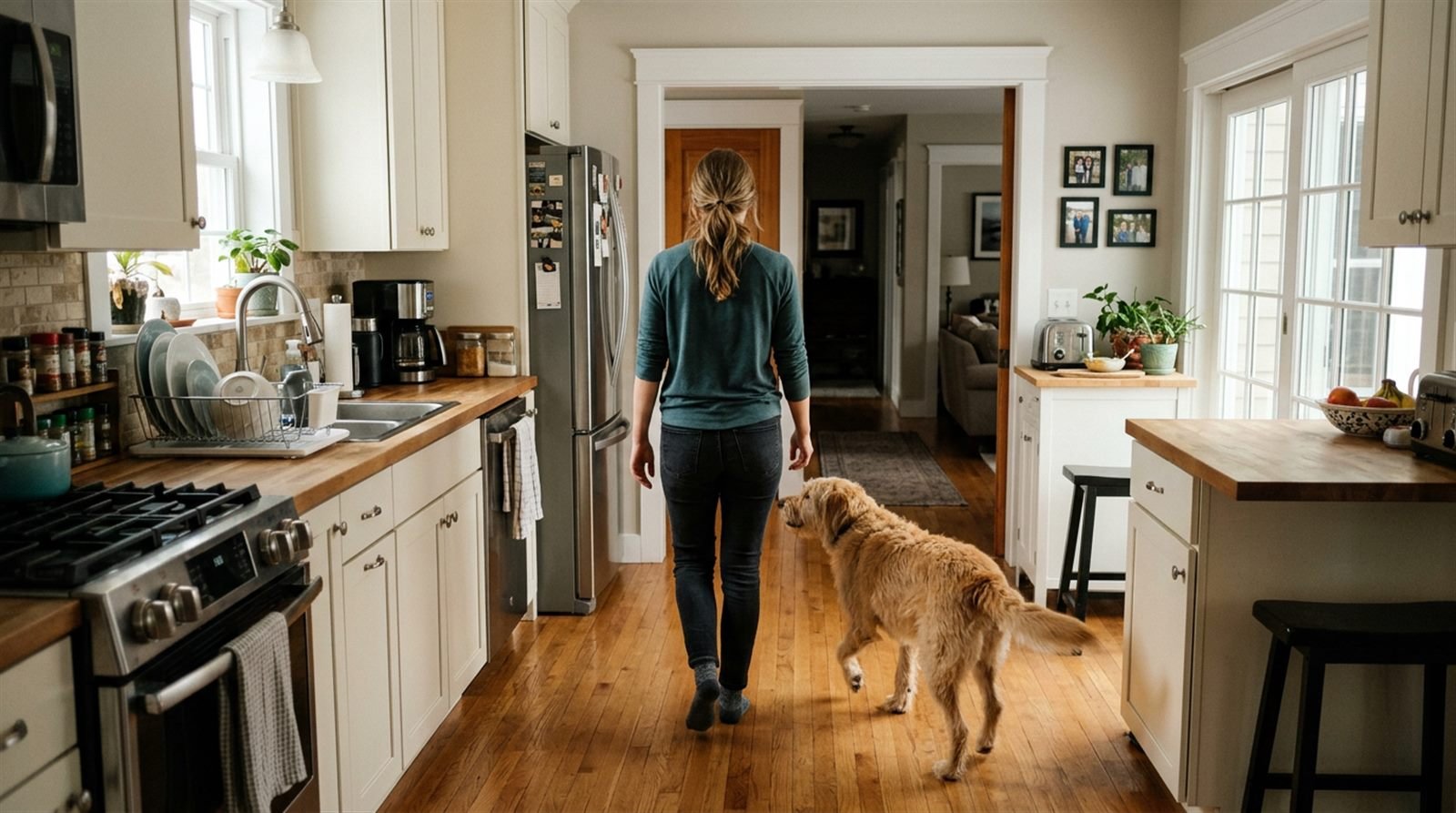
You get up for a glass of water and gain an escort. You go to the bathroom and there is a nose under the door. Most of the time this is exactly what it looks like — a social animal choosing to be near its favorite person.
But it is also one of the few behaviors that can quietly predict a problem you have not seen yet, because it happens while you are home and the trouble happens while you are not.
Following you around is normal for most dogs and needs no fixing. The version worth attention is the dog that cannot settle unless it is touching you, that gets up every single time you shift position, or that starts pacing when a door closes between you. That dog has never learned to be apart while calm — and being alone is a skill, not a default.
The ordinary reasons
They are a social species. Dogs evolved alongside us and spent thousands of years being selected for wanting to be near us. Staying close is the baseline, not the anomaly.
You are the source of everything good. Food, doors, walks, the interesting cupboard. Following you is a rational strategy that has been reinforced every day of your dog's life.
Breed. Herding and companion breeds in particular were shaped to work in close contact and check in constantly. A shepherd that watches your every move is doing its job.
Something changed. A move, a new baby, a schedule change, a household member leaving. Dogs tend to stick closer while the ground is shifting, and it usually settles again.
When it is worth a second look
Four patterns turn ordinary shadowing into something worth working on:
- Your dog cannot settle unless it is in contact with you. Not in the same room — touching.
- It gets up every time you shift. You reach for a mug and the dog is on its feet.
- A closed door produces distress. Whining, scratching, pacing outside the bathroom.
- It tracks your departure cues. The dog is already up and pacing at the shoe stage, before you have gone anywhere.
That last one is the strongest signal, because it means the anxiety is running before you have left the house. If you recognize it, the camera test is the next thing to do.
🔴 Sudden clinginess is a medical question first
A dog that was independent last month and cannot leave your side this month needs a veterinary exam before anything else. New clinginess in an adult dog is a recognized presentation of pain, illness, hearing or vision decline, and cognitive dysfunction in older dogs.
Behavior that changes gradually is usually behavior. Behavior that changes quickly is usually a body.
Teaching the skill of being apart
You are not teaching your dog to want you less. You are teaching it that distance is survivable and boring — which is exactly what you need it to believe when you go to work.
- Give it a place. A bed or mat in the room you are usually in. Feed something excellent there, several times a day, for nothing.
- Add distance in inches. Dog on the mat, you take one step away, come back, drop food. Build to crossing the room.
- Introduce the doorway. Step out of sight for two seconds. Return before your dog gets up. Two seconds is genuinely the starting point for many dogs.
- Make doors ordinary. Close the bathroom door for five seconds while your dog is calm and busy. Open it before the whining starts, not after.
- Feed apart sometimes. A chew in a separate room turns being alone into something good rather than something that happens to them.
The rule underneath all five: return before the distress, not after it. Coming back to a whining dog teaches that whining brings you back. Coming back to a calm dog teaches that calm is safe.
What not to do
Do not shut the dog out to "break the habit". Isolating a dog that already struggles with distance does not build tolerance; it confirms the fear. The point is graded practice, not cold turkey.
Do not get a second dog for this reason. Separation distress in dogs is typically about a specific person, not about solitude. Most people who try this end up with two dogs waiting at the door.
Do not scold the following. The behavior is a symptom. Punishing it adds anxiety to a dog whose problem is anxiety.
Frequently asked questions
Is it normal for a dog to follow you everywhere?
Largely yes. Dogs are a social species and many breeds were selected to work in close contact with people. Following becomes a concern when the dog cannot settle unless it is touching you, panics when a door closes between you, or shows distress the moment you stand up.
Does a velcro dog mean separation anxiety?
Not by itself. Plenty of dogs shadow their owners at home and are perfectly calm alone. The two overlap often enough to be worth checking with a camera, but shadowing on its own is not a diagnosis.
Should I stop my dog from following me?
There is no need to stop the behavior itself if your dog is otherwise relaxed. What is worth building is the ability to settle in a separate room without distress, because a dog that has never practiced being apart has no skill to fall back on when you leave.
Why has my dog suddenly become clingy?
A sudden change deserves a veterinary exam. New clinginess in an adult dog is a recognized presentation of pain, illness, vision or hearing decline, and cognitive change in older dogs. Behavior that changes quickly is a medical question first.